


In Vitro Meat (IVM) - Digital futures: future scenario report and poster
- Lianne Yu

- May 1, 2024
- 10 min read
Introduction
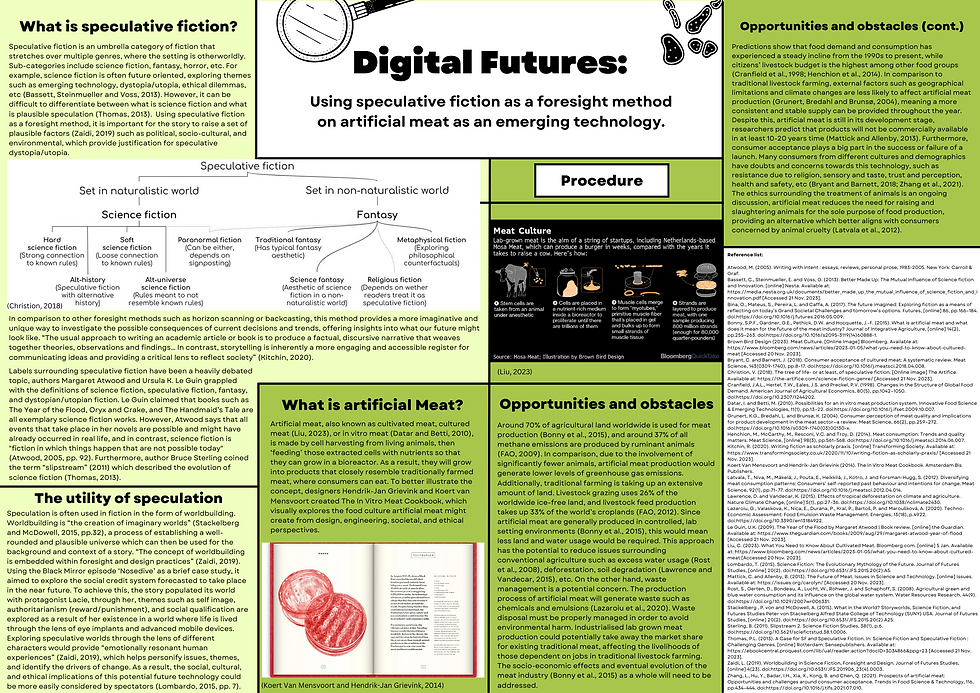
“Disgust elicited by fake meat” has previously been used as a “flash point for eco-minded critique” (McHugh, 2010, pp. 181). The protagonist, George Bowling of Orwell’s novel Coming Up for Air (1939), described artificial meat as “rotten fish in a rubber skin” and “bombs of filth”. However, readers nowadays might not completely resonate with this notion. Artificial meat, also called in vitro meat (IVM) or cultivated meat, is produced through the vitro cultivation of animal tissues or cells, such as stem cells and myocytes (Bonny et al, 2015, pp. 256). IVM is typically created in a controlled laboratory environment. This emerging technology is often considered to be a potential alternative for traditional livestock meat production (Post, 2012, pp. 297) because of its slaughter-free nature. In December 2020, Singaporean private members’ club 1880 debuted their first dish featuring lab grown chicken, making them the first to sell and serve cultivated meat at a restaurant (Noyes, 2020). Companies such as Eat Just, Upside Foods, and Mosa Meat have been major drivers of change in the food industry (Shah-Neville, 2023). Until now, the only country where IVM can be legally sold is Singapore, but looking at recent developments, the US and UK could possibly be next in line (Francis, 2023). In November 2022, the FDA gave approval to California startup company Upside Foods to start selling their cultivated chicken (Torrella, 2022). As of the date of writing, the British government is fast-tracking to sign a bilateral agreement with Israel, in order to accelerate collaboration on lab grown meat (Pinkstone, 2023).
Foresight method
Speculative fiction is a literary genre that explores different types of possible futures. Works from this genre often include themes which extrapolate from current, emerging technologies, trends, and societal dynamics (Bassett, Steinmueller and Voss, 2013). As a foresight method, speculative fiction offers researchers an avenue to creatively explore what might be. It is used as a “future-oriented research approach” (Kymäläinen, 2016) primarily within the science and engineering fields. This method can be used to examine potential pending consequences of current decisions and progressive trends, in turn providing insights into what and how future events might take place.
Speculative fiction as a method goes beyond traditional foresight methods such as scenario predictions (horizon scanning, backcasting), or trend analysis, by leveraging imaginative storytelling to envision plausible future realities (Kitchin, 2020). To explore this chosen emerging technology, speculative fiction could provide a more engaging and personally resonant platform to reflect society, in contrast to horizon scanning being heavily evidence based (Schultz, 2006), and backcasting possibly being restrictive or biassed due to its nature of preferability (Robinson, 1988; Bibbri, 2018).
Researchers argued that the future of artificial meat can be better understood through the lenses of science fiction (McHugh, 2010; Nye, 2020; Castle, 2022;), both contemporary and historically. The rise of science in the 1600s correlates with the birth of the science fiction genre (Thomas, 2013). The empirical nature of science reciprocally impacts speculative fiction, “The more science itself became an empirical, experimental discourse… the more important science fiction became” (Roberts, 2005, pp. 60). The concerns and dilemmas surrounding artificial meat have been central themes in literature works dating back to the 1930s. Winston Churchill’s 1931 article Fifty Years Hence predicted the potential rise of lab grown meat; and George Orwell’s 1939 novel Coming Up for Air explored the possibilities of a society under the industrialisation of artificial meat production. Although some of these technological attributes were “far-fetched” at the time, traits that were labelled “sensible autonomy” for the system eventually became targets of industries (Cook, Augusto and Jakkula, 2009, pp. 278) as evidenced by the current scientific progress and commercial developments of artificial meat.
Future scenario
The year is 2047, the culinary world has just experienced a radical change. Artificial meat - once a groundbreaking invention, has become the norm. Enormous bioreactor farms have replaced the once thriving fields of traditional livestock farms. Skyscrapers contained laboratories where culinary researchers and scientists worked tirelessly to create protein rich flesh from delicately developed animal cells. The overwhelming glow of neon projections advertising the latest lab-grown products plastered all over the city:
“Meat Thneed! Cultivated from animal muscle tissue, moulded into extra long yarns of meat, knitted into an aesthetically pleasing steak.”
“Cultured Cocktails! Experimental savoury cocktails made by our professional baristas - no combination is off limits! We will happily mix orca meat with sake, or in vitro bacon with rum.”
“Star Stew! Posters and autographs are simply not enough, you can now eat your favourite celebrity! This stew is made from the stars’ stem cells, a uniquely addictive dish.”
In this era of progress, Ava, an acclaimed food journalist, has found herself at the crossroads of progression and nostalgia.
Ava’s career had flourished in a former era when the farm to table social movement was at its prime, when the majority of consumers greatly valued small-scale and locally farmed food produce. However, as society embraced the newness of lab grown substitutes, her articles seemed to take on an increasingly defensive tone, perhaps as an attempt to juggle innovation and resistance.
As the sun dipped underneath the horizon, casting an orange glow over the city, Ava returned to her loft tucked away from the bustling roads. She was greeted by the familiar smell of synthesised cuisine, lingering in the air. To Ava, this very smell represents progress, a new era of gastronomy, one where she worked tirelessly to adapt to. However, she was acutely aware of the fact that not everybody shared her enthusiasm.
Bella, her eighteen year old daughter, sat cross legged on her swivel pod chair. She turned to face the holographic dining table, absentmindedly tracing designs on the screen with her fingertips. The subtle hum of the 3D meat printer filled the room, a device Ava had become dependent on quickly, but for Bella, this machine represented a challenge, an unnecessary hurdle between her and her already turbulent relationship with food. The front door opens, “Bella, I’m home,” Ava scans the living room before seeing her daughter sitting quietly by the table. “Have you eaten?” She asked, already knowing the answer. Bella stayed silent, avoiding eye contact, her once vibrant eyes now reflecting a complexity of emotions. Ava turned her attention to the meat printer, swiftly pressed a few buttons on her machine that she has become so familiar with. “That looks so… plastic…” Bella looked at the transparent, jelly-like slices being generated. “Thought we could try something new, it just came out today,” Ava leaned in closer to the screen, looking at the description of this newly released dish, “See-through otoro… it looks pretty good, no?” Reluctant, Bella pursed her lips.
Ava sighed, guilt and worry etched across her face. Her daughter's reactions seemed to echo the public’s disdain towards artificial meat. The comments section of her articles were once filled with praise and excitement, but now it has become a battlefield for discourse and arguments. Traditionalists mourned the loss of authenticity and accused her of being a pawn in the hands of profit hungry industry conglomerates - which is not entirely false. Ava’s integrity in journalism had clashed with her need to make a living. The increasing demands from her editor-in-chief are often associated with advertising avenue from food technology corporations. As she struggled with ethical dilemmas in her dwindling career, the strains on her relationship with Bella intensified.
In her next project, Ava received an assignment that represented the epitome of this challenge - a review on a newly opened upscale restaurant, V-Bistro. Carla, the ambitious head chef, had prepared a trailblazing menu that pushed boundaries of in vitro food culture. As Ava entered the restaurant, she was greeted by a fusion of elegant and avant-garde interior. The aroma of dishes surrounded her. While each course was artistically curated and carefully presented, they still elicited a hint of resistance from the other patrons. As Ava tasted each dish, her mind wandered endlessly on how she should articulate the superb flavours without dismissing the audiences’ profound connection and nostalgia towards traditional meats.
Back home, Bella’s anorexia worsened, aggravated by a culture in flux and a mother who, despite her best efforts, struggled to understand the complexity of her daughter’s illness. As the ambiance of the city faded with the night, Ava attempted to broach the subject with Bella. “I know it’s more about control, Bella. It’s not just because of the food, isn’t it?” Bella met her mum’s gaze, her eyes showed a mixture of frustration and vulnerability “No, it’s not just that,” She paused and sighed, “How do you not feel lost in a world where even our food is all fake?” Ava felt an immediate sense of guilt, then came the annoyance at herself, for not being able to find the words that would give her daughter a satisfying answer. The innovation she praised in her work had become the source of friction in her family.
Desperate for a solution, Ava decided to seek guidance from Carla. The chef welcomed Ava into her kitchen and introduced her creations and passionately explained her process. Overtime, Carla became a mentor figure, she helped Ava better understand how people choose to walk the fine line between old and new. Together, they created a series of journals that pursued the demystification of artificial meat. Ava’s work evolved from straightforward critiques to narrative driven pieces that focused more on personal ties to culinary heritage. As her journals gained traction, her comments’ section remained divided. However, amidst the chaos, a community willing to engage in thoughtful conversations about the future of food emerged.
As Ava weathered the storm of public opinions, her relationship with Bella slowly transformed. Bella began to find solace in her mother’s work, forming a support network of individuals also suffering from eating disorders in a society of constant change, bombarding them with conflicting messages about food. Ava also began to accompany her daughter to her therapy sessions.
One night, Ava and Bella sat on their loft balcony. The cityscape filled with technological marvels unfolded before them, the lights twinkled like stars. Suddenly, they heard a low buzz coming from a flickering neon sign…
“New! Quail Origami!”
Bella grimaced, already shaking her head, she gestured to the advert, “Do not add that to our printer.” Ava reluctantly agreed.
Reflection
Artificial meat has been marketed to be the utopic solution for animal cruelty and environmental pollution (Castle, 2022, pp. 150). Companies have adopted alternate titles for artificial meat such as slaughter-free meat and clean meat, now that retail extensibility is on the horizon. However, in speculative fiction, questionable and controversial ethical frameworks have developed within the worlds built in these stories. As a result, they help highlight the potential obstacles and issues which may arise in the real world, when artificial meat companies have promised a cruelty free future.
To reflect and review this method and proposed future scenario, although some key socio-cultural, political, and ethical themes surrounding artificial meat have been highlighted, this scenario was majorly based on research of the western ideologies. In order for this research to be more well-rounded, point of views of different cultures and ethnic demographics must be explored, due to the difference of issues and concerns that might arise depending on the geographical area.
Through the exploration of protagonist Ava, readers could gain insights into the polarising opinions on artificial meat, the fact that there could be contradicting factors in people’s actions and priorities, such as personal ideologies, morals, ethical concerns, and practical challenges such as money, family, and work life balance. The protagonist represented how emerging technologies might be accepted and depended upon not due to the beneficial nature of the technology or personal likes/dislikes, but out of compromise or pressure felt under authoritarian structures. Authoritarianism is explored through the protagonist’s company and its editor-in-chief, they represent the main drivers of change, by having the power to influence the opinions of the masses through advertising, and hold the power of some of the protagonist’s personal decision making through company hierarchies. This highlighted how appropriate governance and proper regulations must be put in place in order to minimise issues that may derive from the holding of excess power by corporations. In addition, consumer acceptance has always been a challenge faced by the food industry, which artificial meat is not exempt from (Bryant and Barnett, 2018). Bella as a character represented the reluctant crowd, highlighting the themes of social resistance and the fear of the unknown; and the character Carla, as the sage (Iaccino, 1998) of this story, represented a bridge between corporations and individuals. Overall, this report argued that speculative fiction featuring artificial meat utility have the ability to provide a deeper understanding in foresighting and digital futures thinking.
Reference list:
Bassett, C., Steinmueller, E. and Voss, G., 2013. Better Made Up: The Mutual Influence of Science fiction and Innovation. Nesta. Available at:
Bibri, S.E., 2018. Backcasting in futures studies: a synthesized scholarly and planning approach to strategic smart sustainable city development. European Journal of Futures Research, 6(1), pp.1-27. Available from: https://doi.org/10.1186/s40309-018-0142-z
Bonny, S.P., Gardner, G.E., Pethick, D.W. and Hocquette, J.F., 2015. What is artificial meat and what does it mean for the future of the meat industry?. Journal of Integrative Agriculture, 14(2), pp.255-263. Available from: https://doi.org/10.1016/S2095-3119(14)60888-1
Bryant, C. and Barnett, J., 2018. Consumer acceptance of cultured meat: A systematic review. Meat Science, 143(0309-1740), pp.8–17. Available from: https://doi.org/10.1016/j.meatsci.2018.04.008
Castle, N., 2022. In vitro meat and science fiction. Extrapolation, 63(2), pp.149-179. Available from: http://dx.doi.org/10.3828/extr.2022.11
Churchill, W., 1931. America’s National Churchill Museum | Fifty Years Hence, Winston Churchill December 1931. www.nationalchurchillmuseum.org. Available at: https://www.nationalchurchillmuseum.org/fifty-years-hence.html
Cook, D.J., Augusto, J.C. and Jakkula, V.R., 2009. Ambient intelligence: Technologies, applications, and opportunities. Pervasive and mobile computing, 5(4), pp.277-298. Available from: https://doi.org/10.1016/j.pmcj.2009.04.001
Francis, A., 2023. Will I See Lab-Grown Meat in Supermarkets Any Time Soon? Bon Appétit. Available from: https://www.bonappetit.com/story/lab-grown-meat
Iaccino, J.F., 1998. Jungian Reflections within the Cinema: A Psychological Analysis of Sci-Fi and Fantasy Archetypes. Bloomsbury Publishing USA.
Kitchin, R., 2020. Writing fiction as scholarly praxis. Transforming Society. Available at:
Kymäläinen, T., 2016. Science fiction prototypes as a method for discussing socio-technical issues within emerging technology research and foresight. Athens Journal of Technology & Engineering, 3(4), pp.333-347. Available from: 10.30958/ajte.3-4-4
McHugh, S., 2010. Real artificial: Tissue-cultured meat, genetically modified farm animals, and fictions. Configurations, 18(1), pp.181-197. Available from: https://doi.org/10.1353/con.2010.0006
Noyes, A., 2020. Eat Just Follows Regulatory Approval With Historic, First-Ever Sale of Cultured Meat. Business Wire. Available from: https://www.businesswire.com/news/home/20201215006155/en/Eat-Just-Follows-Regulatory-Approval-With-Historic-First-Ever-Sale-of-Cultured-Meat
Nye, C., 2020. The Matter of In-Vitro Meat: Speculative Genres of Future Life. The Palgrave Handbook of Twentieth and Twenty-First Century Literature and Science, pp.375-395. Available from: https://doi.org/10.1007/978-3-030-48244-2_21
Orwell, G., 2021. Coming up for Air. Oxford University Press, USA. pp. 27–28. Available from: https://books.google.co.uk/books?id=UxUOEAAAQBAJ&lpg=PP1&ots=KHCe3AZCVB&dq=coming%20up%20for%20air%20orwell&lr&pg=PP1#v=onepage&q=coming%20up%20for%20air%20orwell&f=false
Pinkstone, J., 2023. UK to fast-track approval for lab-grown meat with Israel deal. The Telegraph. Available from: https://www.telegraph.co.uk/news/2023/09/29/uk-lab-grown-meat-fast-track-approval-israel-deal/#:~:text=No%20lab%2Dgrown%20meat%20is,the%20forefront%20of%20the%20movement.
Post, M.J., 2012. Cultured meat from stem cells: Challenges and prospects. Meat science, 92(3), pp.297-301. Available from: 10.1016/j.meatsci.2012.04.008
Roberts, A., 2005. The history of science fiction. New York, NY: Palgrave Macmillan.
Robinson, J.B., 1988. Unlearning and backcasting: rethinking some of the questions we ask about the future. Technological forecasting and social change, 33(4), pp.325-338. Available from: https://doi.org/10.1016/0040-1625(88)90029-7
Schultz, W.L., 2006. The cultural contradictions of managing change: using horizon scanning in an evidence‐based policy context. Foresight, 8(4), pp.3-12. Available from: doi:10.1108/14636680610681996
Scipioni, J., 2020. This restaurant will be the first ever to serve lab-grown chicken (for $23). CNBC. Available from: https://www.cnbc.com/2020/12/18/singapore-restaurant-first-ever-to-serve-eat-just-lab-grown-chicken.html
Shah-Neville, W., 2023. 6 cultured meat companies making waves. Labiotech. Available from: https://www.labiotech.eu/best-biotech/cultured-meat-companies/
Thomas P. L., 2013. Science Fiction and Speculative Fiction: Challenging Genres. Brill. Available from: ProQuest Ebook Central https://ebookcentral.proquest.com/lib/ual/reader.action?docID=3034866&ppg=23
Torrella, K., 2022. FDA approval puts lab-grown meat one step closer to your dinner plate. Vox. Available from: https://www.vox.com/future-perfect/2022/11/17/23462902/lab-grown-meat-upside-fda-approval-usda-cultivated-meat-animal-welfare
Wurgaft, B. A., 2014. The In Vitro Meat Cookbook: Recipes as design fiction. Medium. Available from: https://medium.com/re-form/the-in-vitro-meat-cookbook-321aad71ce9a


Comments